I strongly believe that the MAHA movement is one of the most beneficial results of Donald Trump’s recent victory. As RFK Jr. has already pointed out, the food supply in the United States is full of poison. Obviously it’s not the type of poison that will kill you right away and probably not even in a decade, but do we actually know the cumulative health effects of consuming it for three or four decades or an entire lifetime? Maybe not but I believe, as does RFK Jr., that the failing health and poor physical condition of so many Americans is an indication.
Why is it that so many ingredients that are permitted to be added to our food supply in the U.S. are banned in Europe and other countries? Do other countries prohibit those ingredients just to make life difficult for food manufacturers? Or is it because they believe those ingredients are harmful to public health? The latter seems much more likely than the former, does it not?
I know it may be difficult for the average person to think of their own government as an entity that has no genuine concern for their well-being but the evidence surely seems to lead us to that conclusion. These agencies have the power to regulate what goes into the food supply and that are knowingly allowing a staggering number of ingredients that are known to be detrimental to human health.
I am fairly confident that these harmful ingredients are not being permitted because regulatory agencies want to harm the American people. That’s surely the result of these policies but it is not likely to be the motivation. The motivation is greed.
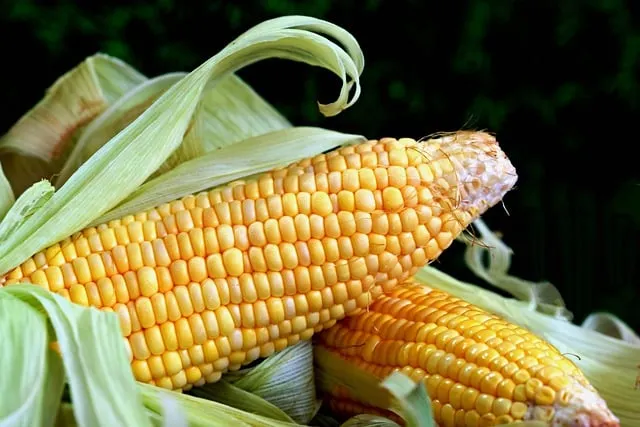
Food manufacturers benefit financially from using those ingredients in various ways depending on the ingredient. Sometimes it is a cheap way for them to improve the appearance of their products, making them more attractive to consumers. Other ingredients may be added to improve the product’s shelf life and as a result the product will be less likely to be discarded by retailers because it has been on their shelves too long. And then there are the harmful ingredients that may be added as a cheap way to improve the product’s flavor. Corn syrup may be the best example of Big Food’s quest for better-tasting products that cost them less to produce.
Although we are still over two months away from Trump taking office, it does not seem too soon to start thinking about what might happen when he does. Although I am anxious to see many of the positive changes he will usher in, I am especially passionate about health and wellness because poor health and disease cause so much pain, misery and human suffering right here in our country and it does not have to be that way.
The general poor (I might be justified using the word “pathetic” in this context) health of the American populace is not due to some outside force beyond our control. It’s not because a meteorite crashed to earth and delivered a dangerous pathogen. And it’s not because some exotic virus managed to mutate inside the body of a bat, monkey or pangolin and was passed on to humans. It’s because harmful ingredients are being added to the food supply with the full and complete knowledge that those ingredients are indeed harmful. In other words, all that’s needed to dramatically improve the health of most Americans is to stop adding those harmful ingredients to our food supply.
I feel very confident that removing these harmful ingredients from our food supply would dramatically reduce incidences of heart disease and cancer in the United States. I also would not be the least bit surprised if we also saw a tremendous reduction in conditions like Alzheimer’s, Parkinson’s and so-called autoimmune conditions like Multiple Sclerosis, Rheumatoid Arthritis, Lupus, Type 1 Diabetes and others.
And what in the world are we doing to our children? More of them than ever are overweight and suffering from conditions that were virtually unheard of in children not all that long ago. Rates of Type 2 Diabetes have been steadily rising in children and are currently at never-before-seen levels. Without a change to the dietary habits this trend is likely to continue worsening and the most important change that can be made may be to eliminate the consumption of harmful food ingredients. Well informed parents have been doing this for years but sadly, they are a small minority. Most parents simply are not aware of the dangers and believe that everything found on supermarket shelves is safe and healthy to eat. They could not be more wrong.
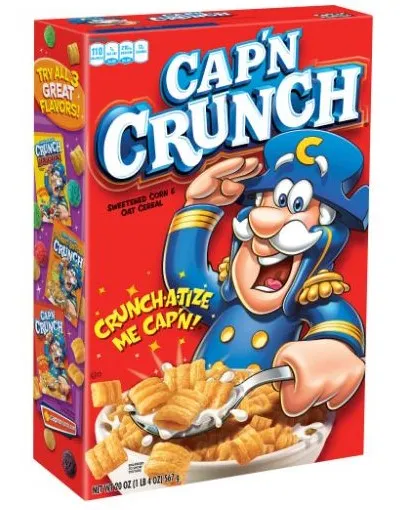
While we’re on the subject of children it seems like an appropriate time to move on to the star of our show: Cap’n Crunch cereal.
Before I get further into it, I want to make something abundantly clear. I absolutely love Cap’n Crunch cereal. I am being completely serious in saying that. I could sit down and eat an entire box of it. It is one of my favorite breakfast cereals of all time and I recall eating it regularly when I was a kid. And yes, the old Cap’n has been around a long time! And when I say ”Cap’n Crunch” I mean the original and legitimate version and not the stuff with “Crunchberries” and all the other nonsense versions they concocted over the years. For me, it’s the original or nothing. I am a dedicated Cap’n Crunch purist!
My family was pretty big on breakfast cereals when I was growing up. In fact, that was probably what we we ate for breakfast 80 percent of the time and we loved it. My dad loved it too and he was sitting there eating it right along with my brother and me. It was quick and easy and most of the time it tasted great. I was less enthusiastic about family staples like Shredded Wheat, Total and Corn Flakes but those seemed to be my Dad’s favorites so they were often on the table and I thought they were tolerable. I favored more sugary offerings like Lucky Charms, Froot Loops and Frosted Flakes and of course, Cap’n Crunch. Unfortunately, I still do.
Looking back now it seems a bit odd that my parents seemed to believe that cereal for breakfast was just fine. Especially since they were so health conscious in other ways such as making sure we took our vitamins on a regular basis and always drank spring water. Perhaps they just didn’t feel that sugar was all that bad and frankly, as someone who respects the Ray Peat approach to health, I am not sure it is actually as bad as we have been led to believe.
What my parents probably did not need to worry themselves about all those years ago was the knowledge that the breakfast cereal they were feeding their kids was loaded with harmful ingredients. During the 1960s and 1970s when I was eating Cap’n Crunch somewhat regularly there just did not seem to be the same awareness about unhealthy food compared to what’s available today. And “available” is a key word. While that type of information was much more difficult to locate back then, today the internet offers more information on that subject than a single person could consume in a lifetime. The problem is, apparently, that not too many people are looking for it. That is one thing I hope that the MAHA movement can change.
So what exactly is in Cap’n Crunch cereal? The most current list of ingredients I was able to locate reads as follows: Corn flour, sugar, oat flour, vegetable oil (coconut oil or palm oil), salt, molasses, reduced iron, Yellow 5, niacinamide (vitamin B3), Yellow 6, BHT, thiamine mononitrate (synthetic thiamin), pyridoxine hydrochloride (vitamin B6), riboflavin (vitamin B2) and folic acid (vitamin B9).
One thing I will admit about my old friend The Cap’n is that the ingredients could be worse. Still, I definitely have problems with “Yellow 5,” which is also known as Tartrazine, a particularly insidious additive that RFK Jr. recently talked about. “Yellow 5” sounds much more approachable and innocent, does it not? I’m sure the makers of Cap’n Crunch (food giant PepsiCo) would rather not print “Yellow dye derived from petroleum” on the box because eating oil does not sound that appealing. Tartrazine may also show up on ingredient lists as E102.
I guess a little petroleum with your cereal wasn’t quite enough so PepsiCo decided to add more. Yes, “Yellow 6” is another petroleum-derived artificial color. As best I can recall, Cap’n Crunch cereal is indeed yellow but does is really require two separate artificial yellow food colorings? What color would Cap’n Crunch be without the addition of those two colorings? Judging by the ingredients, my guess would be some variation of white or perhaps somewhat beige. What are the chances that would cause people who have been eating it for years to reject it? Perhaps a few but I suspect it would be a vanishingly small number. I know it would not deter me!
PepsiCo is probably terrified over the notion of making such a change. How could they ever endure what would likely be a low single digit percentage drop in sales? I’m sure they would be closing up shop in short order as a result! Once again, it’s the greed that compels them to turn a blind eye toward the notion that they are poisoning people; including children. Never mind that and get back to counting the money!
I would wager heavily that there are a number of natural and healthy options that could be used to replace those artificial colors and would be quite capable of duplicating that classic Cap’n Crunch color. How about something like Turmeric? Since I am very familiar with both Cap’n Crunch and Turmeric, I feel confident that the traditional color of the product could be successfully duplicated with this natural coloring.
What about eliminating the coloring entirely as I suggested above? Sure, that would change the color of the product quite noticeably but what if they accompanied the change with a marketing campaign boasting about how much healthier the product is without the inclusion of coloring? Now might be the perfect time for such a move since it would be in time to reap the benefits of a more informed consumer base that will finally be hearing the truth about our food supply from the MAHA movement.
In addition to the unhealthy coloring, Cap’n Crunch also includes BHT as a preservative. BHT is shorthand for butylated hydroxytoluene. And doesn’t that sound like something you would like to ingest on a regular basis? Long-term exposure to high doses of BHT was shown to be toxic in mice and rats, causing liver, thyroid and kidney problems. It also affected lung function and blood coagulation. BHT can also act as a tumor promoter in some instances. There is evidence that suggests that high doses of BHT may mimic estrogen, the primary female sex hormone, and interfere with male sex hormones, causing adverse reproductive effects.
“But you admit that it was only high doses that caused problems in mice and rats!” I can hear the ScienceTM defenders sputter. That is indeed what it said, however, what about low doses over a period of decades? Is it impossible that would have harmful effects? I don’t even think the ScienceTM defenders would go along with that.

So how necessary is a preservative such as BHT for a product like Cap’n Crunch breakfast cereal? I do not know the answer to that but I do wonder how long a product like that would last on a supermarket shelf. That stuff is about as a dry as dry can be so it seems like it could last a while but that is pure speculation on my part and perhaps it would spoil sooner than I would expect.
What about natural preservatives? I decided to consult AI about natural preservatives that could be used to preserve freshness in those kinds of products and it suggested that vitamin E, rosemary extract, ascorbic acid and essential oils would be potential candidates. Could they make some of those work with Cap’n Crunch? Seems like it would be worth a try and would be a nifty project that would help keep the food scientists employed at PepsiCo.
But since switching to a natural preservative would likely be more costly, it is unlikely to occur unless new regulations force them. I, for one, would be willing to pay more for a more natural product. With the return of President Trump, it would probably still be less expensive than it is now due to the absence of inflation that the Biden regime brought us.
The downside of improving the ingredients in something like Cap’n Crunch is that people like myself would be more inclined to eat it more often. That surely would not be as bad an activity as it would be today with the current unhealthy ingredients but I still do not consider it particularly healthy to make breakfast cereal a regular thing. I certainly had my share of it during childhood but I find that I enjoy it just as much (or more!) than I did then.
After preaching about the unhealthy ingredients currently included in Cap’n Crunch cereal and admitting how much I love it at the same time, you might be wondering when the last time was that I had some. I do not know precisely when that was but my best guess would be around two or three years ago. That experience reinforced how much I still love the taste of that stuff.
I will have it again and perhaps that will not be too far in the future. I have to believe that enjoying some on rare occasions is not that harmful, so in exchange for the enjoyment I get from having some, I am willing to accept what is likely to be a very small risk. If PepsiCo is eventually forced to make Cap’n Crunch with healthier ingredients, as I hope they will, then all bets are off. Just kidding. I think.