I’m not sure I ever even heard the word “misinformation” previous to 2020 but now I think I rarely get through a day without hearing it at least once. It is a word that has been embraced by those on the left as part of their endless effort to turn the truth on its head.
Anything that doesn’t align with their narrative is labeled “misinformation, disinformation or malinformation.” But those of us who know the left well are not fooled by their tricks. In fact, where the left is concerned, one might be tempted to say that everything they say is a lie. Obviously, that’s not the case since it is possible that at one time in human history a leftist stated that the sky was blue.
One reason it is easy to tell they are liars is because instead of having the courage and decency to argue in support of their ideas, they instead seek to silence the opposition. That’s why conservative voices are often censored on social media. And that’s why people can be “cancelled” and fired from their jobs when they say something that contradicts the left’s agenda. The left knows their arguments do not hold up well under scrutiny and as a result, they scream in your face and try to drown you out or, if they can, have you cancelled and silenced.
It’s the left that has more-or-less resurrected the word “misinformation” in recent years and that made me wonder if it was a real word. Apparently, it is. It is said to have first been uttered way back in 1605. Still, it’s difficult to use that word without feeling a bit like you are spewing leftist propaganda, but considering that it is indeed a real word, I’m not going to allow the left to appropriate it and claim it as their own.
With that in mind, let’s talk about an example of misinformation that surfaced today on X, formerly known as Twitter. I use X every day and check it periodically through the day so I can stay informed about what’s going on in the world. This morning as I was scrolling through my feed I saw the following post:
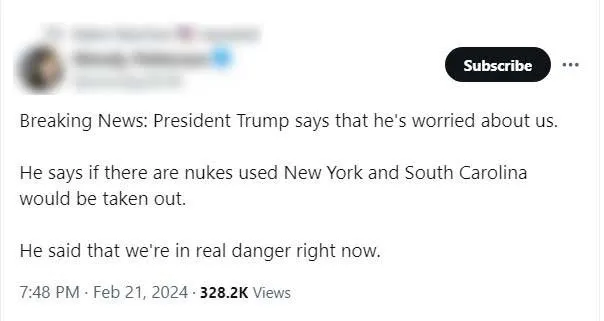
I suspect that most people, when they read that post, thought it meant what I thought it meant. To me it implied that both New York and South Carolina will be selectively targeted if there were a nuclear war. Other X users, understandably, wondered why in the world a place like South Carolina would be singled out as a target during a nuclear exchange. New York makes sense since it is the largest city in the country and is a major population center. But why a relatively rural state like South Carolina?
It’s quite understandable that people, and especially those in and around South Carolina, would be quite concerned to learn that they may be living near a place that is considered a primary target if a nuclear exchange takes place. I suspect the people in New York already know they are a target, especially when once considers the terrible events of 9/11/2001.
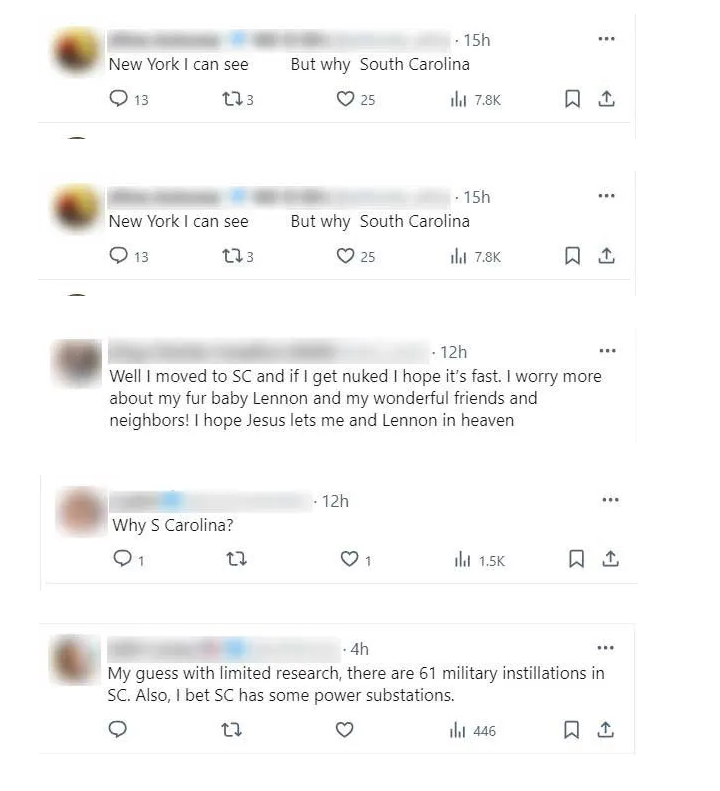
It’s clear that many people took the information seriously and believed that South Carolina was a priority target. I admit that I did. But it seemed odd to me so that is why I decided to dig a little deeper.
The information about South Carolina being a target originated with comments Donald Trump made during a recent town hall event. However, Trump’s comments did not actually indicate that South Carolina is going to be targeted with any particular priority during a nuclear exchange. Apparently, these are the comments he made that somehow resulted in some people believing that South Carolina is designated as a priority target during a nuclear exchange.
The key thing to realize here is that the town hall event Trump as speaking at was in South Carolina. He mentioned South Carolina because he was in South Carolina speaking with a bunch of people from South Carolina. He only mentioned it because he was obviously talking about the overall destruction that would likely occur during a nuclear war and was just driving home the point that all of us in the country are at risk under those circumstances.
The X post pretty much took his comments out of context and as a result, the meaning of Trump’s words were basically lost in translation, so to speak. The X user appears to have jumped to conclusions and perhaps did not actually hear his comments. Perhaps the X user was just passing on something they had been told.
Making what was likely an unintentionally inaccurate post like this on social media is by no means the end of the world. Presumably, no one with personal connections to South Carolina had a heart attack of anything, but as you can see from some of the responses to the post, clearly some people were a little alarmed.
The lesson here is that people make mistakes and mistakes can spread misinformation without intending to. It might be wise for all social media users to stop and take a moment to think before posting something. Especially when one has a substantial number of followers as this X user does. I think everyone feels better when they know the information they post is factual and accurate. At the same time, I realize everyone makes mistakes and that is surely true of me!
I guess the bottom line is that I thought this was a good example of how misinformation can start and then spread very quickly. And that misinformation is a valid term that is not reserved for use by those on the left. When you think about it, however, you have to acknowledge that the left are experts concerning misinformation since one of their foundational tactics is spreading as much of it as they can manage.